The story of travel continues
By: Jorge Alberto Escobar de la Cuesta
PART 7
The First Milestones of Accommodation
Welcome back.
Chapter 6 was titled “The Grand Tour, the Romantic Travelers, and the First Luxury Hotels,” but at this point it is worth pausing and picking up the thread from a different perspective: the evolution of hospitality.
So far, we have covered more than four thousand years of travel history—from the first Neolithic caravans to the Romantic travelers of the eighteenth century. But there is another story that has barely been hinted at, one that deserves a moment of attention: the story of where the traveler slept.
Because if the history of travel is the history of humanity in motion, the history of accommodation is the history of how we host one another. And that history is as ancient, as rich, and as surprising as the history of travel itself.
In this chapter, we will travel across more than sixteen hundred years, from the early centuries of the Common Era to the end of the sixteenth century.
1. Rome: The First Organized System of Accommodation and State Logistics in History
In the early centuries of the Christian era, when the Roman Empire was at its height, its roads—drawn with precision and paved in stone, so solid and enduring that some are still in use today—connected more than 400,000 kilometers of territory, from the misty coasts of Britannia and sun-drenched Hispania to the deserts of Mesopotamia and Egypt. Along them traveled soldiers, merchants, diplomats, pilgrims, and imperial officials.
And all of them needed a place to sleep.
The Romans responded to that need with a sophistication that Europe would not see again for centuries. It was not merely a matter of roads, but of an entire system: a network designed to move people, information, and power with extraordinary efficiency.
That system—the cursus publicus—worked as follows:
For travelers in the service of the State, there were the mansiones—from the Latin mansio, which can be translated as “official roadside inn”: a network of official staging posts distributed along the imperial highways, spaced one day’s march apart. Maintained at public expense, they offered beds, food, stables, and fresh horses exclusively to those bearing imperial authorization. In essence, they constituted one of the first organized systems of state accommodation in history.
For ordinary mortals, travel took place under very different conditions. There were the cauponae, private establishments where the common traveler found shelter with varying degrees of fortune, and the tabernae, commercial spaces where one could eat, drink, and in some cases spend the night—more integrated into daily life than into any infrastructure designed for the traveler.
Their reputation was not exactly sterling: the poet Horace described them as “greasy,” and various contemporary authors associated them with gambling, cheap wine, and dubious company. But they existed, they were functional… and, for better or worse, they were an unavoidable part of the journey.
In the cities, the traveler with means could aspire to a hospitium: a more formal establishment, sometimes set up in a private home that had been adapted for the purpose. These spaces embodied a tradition deeply rooted in the Roman world: hospitality as duty, almost as a moral obligation of the host toward whoever arrived.
That tradition rested on a key idea that would resonate across the centuries: the concept of the hospes. In the original Latin, this word made no distinction between the one who receives and the one who is received; it named, in essence, the relationship between them. From that root would later spring words such as “hospital,” “hotel,” and “hospitality.”
In the hospitium, that ancient notion was not abstract: it translated into dignified treatment and, in many cases, genuine comfort.
Pompeii, frozen in time by the eruption of Vesuvius, allows us to see this world with exceptional clarity. Dozens of these establishments have been identified there: some with their own dining rooms, interior gardens, and private rooms of considerable size; others that, without entirely abandoning the spirit of hospitality, broadened their offerings toward services that had little of the sacred about them.
The Empire also maintained a network of mutationes—horse-relay stations—distributed between the mansiones, completing a mobility infrastructure of surprising efficiency that would have no equal in Europe until the arrival of the railway.
When Rome fell, it was not only its roads and staging posts that collapsed. The very idea that travel could be part of an organized system disintegrated as well. For centuries, moving from place to place would become—as it had been before—an uncertain adventure. But the need to welcome others did not disappear: it changed hands.
And it was the religious institutions, in particular the monasteries, that took up the task of receiving the traveler.
2. The Medieval Church: Hospitality as Sacred Duty
As we saw in the third Chapter of this story, the rise of pilgrimage—toward Jerusalem, Rome, or Santiago de Compostela—shaped a network of roads that required waypoints for shelter and rest. Following the Rule of Saint Benedict—which established that every guest was to be received as if he were Christ—monastic communities developed hospices where pilgrims and travelers could find food, shelter, and rest. This was not a commercial service but a moral duty, deeply rooted in medieval spirituality.
Along routes such as the Camino de Santiago or the Via Francigena—which connected Canterbury with Rome—a continuous network of hospitals and hostels emerged that, in many respects, recaptured the logic of the ancient Roman highways: defined stages, welcoming points, and a steady flow of people being cared for along the way.
In this context, European hospitality ceased to be a matter of imperial infrastructure and became an act of faith: a transformation that would profoundly shape the way the West understood the art of receiving others for centuries to come.
3. The Silk Road: The Inn as a Crossroads of Civilizations
While Europe endured centuries of fragmentation and instability, on the other side of the Eurasian continent one of the most sophisticated lodging infrastructures in history was taking shape.
The Silk Road—a vast network of routes connecting China with the Mediterranean through Central Asia, Persia, and the Middle East—was not a single path but a complex system of overland and maritime corridors that, for more than a thousand years, moved silk, spices, porcelain, gold, ideas, religions, and disease between East and West.
Along that network rose the caravanserais.
The word comes from the Persian—karvan (caravan) and saray (enclosure): literally, a “palace of caravans.” But more than palaces, they were key pieces of an infrastructure designed to sustain the journey.
Built at intervals equivalent to one day’s caravan march, the caravanserais were walled complexes that resembled a fortress more than an inn. Caravans entered through a single monumental gate that could be chained shut at nightfall. A gatekeeper guarded the entrance. In the inner courtyard there were stables for camels, donkeys, and horses; on the upper floor, small rooms for travelers.
But the caravanserais were far more than a place to sleep. They offered not only food and shelter, but the opportunity to exchange goods, access local markets, and interact with people from vastly different regions. The largest had hammams (Turkish baths), a mosque or prayer room, a smithy, a veterinarian for the animals, secure warehouses for merchandise, and even interior bazaars where the first commercial negotiations of the journey began.
Their most important legacy was not commercial but cultural. The caravanserais were true crucibles of civilizations. In their courtyards, Chinese, Persian, Arab, Indian, and Byzantine merchants mingled alongside the occasional European adventurer venturing out in search of new trade routes. Languages were learned there, customs shared, religions transmitted. Buddhism, Islam, Christianity, and Judaism traveled these routes in the hands of merchants. Cities that hosted great caravanserais—Samarkand, Bukhara, Aleppo, Acre—became leading intellectual and cultural centers.
Here, an idea takes shape that still defines hospitality today: accommodation as a place of cultural encounter.
Ibn Battuta—one of the great travelers of this story—described with admiration the caravanserai system in China: at each roadside station there was an establishment with a director and an armed guard. At nightfall, the director recorded the names of all travelers, sealed the gates, and at dawn verified that everyone had safely reached the next point. It was, in essence, a system of guest tracking that any modern hotelier would recognize.
This network of caravanserais stretched from China to the Indian subcontinent, Iran, the Caucasus, Turkey, and North Africa, as well as into Russia and Eastern Europe. Many of these buildings have survived to the present day, and in various regions of Central Asia and the Middle East several have been restored and now welcome guests who sleep beneath the same vaulted ceilings where, centuries ago, merchants and travelers once rested.
In the cities of the Islamic world, these systems were complemented by the funduq (from the Arabic funduq, “hostel”): urban inns that functioned as genuine logistical and commercial hubs. Organized around a central courtyard, they combined storage, lodging, and negotiation space in a single building, allowing merchants to live alongside their goods in secure, controlled environments.
This model was not confined to the eastern Islamic world. In Al-Andalus—medieval Muslim Spain, a bridge between the Islamic world and Christian Europe—it gave rise to the alhóndigas, public buildings for the storage and trade of goods that in many cases also provided lodging for merchants. In cities such as Venice, meanwhile, it evolved into the fondaco (derived from the Arabic funduq), establishments that combined warehouse, residence, and the supervision of foreign trade under state oversight.
Many of these buildings still exist today—especially in cities of North Africa and the Middle East—some restored and repurposed, others transformed into markets or cultural spaces: living testimony to a form of hospitality deeply bound up with commerce.
Most of these establishments were not simply private businesses. They were sustained through the waqf: Islamic charitable endowments that guaranteed their upkeep over time. Thus emerged one of the first forms of self-sustaining hospitality in history.
4. San Gimignano: When Power Was Measured in Height
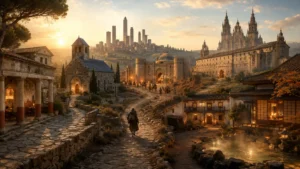
In thirteenth-century Tuscany there existed a small city that served, for pilgrims traveling between northern Europe and Rome along the Via Francigena, as a mandatory stop. Its name was San Gimignano, and what made it unique was not its cathedral nor its wine—though both were notable—but its skyline.
A key point on this pilgrimage route, the city prospered thanks to the constant flow of travelers. The patrician families who dominated it built around seventy towers—some as tall as fifty meters—as symbols of their wealth and power. In their time, these structures dominated the horizon with a height that today would be equivalent to a twenty-story building.
That forest of towers turned San Gimignano into what is today often described as the “medieval Manhattan” of Italy. Rapidly enriched by that flow of travelers, the families entered an informal competition to build towers ever taller and more magnificent. Within the narrow confines of the walled city, growing upward was the only visible form of power.
The Town Council eventually had to step in. In 1255, a law was passed prohibiting the construction of towers taller than the Torre Rognosa—part of the Municipal Palace and, at fifty-two meters, the tallest in the city—in one of the first documented examples of urban regulation in medieval Europe.
Of the original seventy-two towers, only fourteen remain, and even so the profile of San Gimignano is extraordinary. Today, some of them have been converted into unique accommodation, where guests can sleep in thirteenth-century vertical structures.
The phenomenon is telling: it shows how the flow of travelers generates wealth, competition… and, in time, the need to regulate.
5. The Hostal de los Reyes Católicos: Hospitality as an Act of State
As we already saw in the Roman world, the term hospes made no distinction between the one who arrives and the one who receives: it named, in essence, the relationship between them. From that same root come “hospital,” “hotel,” and “hospitality,” reminding us that, at their origin, lodging, caring, and welcoming were one and the same thing.
If San Gimignano represents hospitality as an expression of individual power, the Hostal de los Reyes Católicos in Santiago de Compostela represents something deeper: hospitality as an act of State, as an expression of political power and religious faith at the same time. Something not seen in the West since the days of the Roman Empire.
The story begins in 1486, when the Catholic Monarchs—Isabella of Castile and Ferdinand of Aragon—completed their own pilgrimage to the shrine of Saint James. What they found disturbed them: the sick and the pilgrims wandered the city streets, with no care beyond what small private hospitals or charitable houses could offer. For a monarchy in the process of consolidating its power over all of Spain, such disorder in the most sacred city of the realm was unacceptable.
In 1499, the Catholic Monarchs committed the necessary resources. Construction began in 1501 and took more than a decade. Stonemasons, engineers, and sculptors were summoned from across Europe to raise a building designed not only to provide shelter but to better serve the traveler: to separate functions, organize spaces, and make the pilgrim’s passage through the city a more dignified experience.
The result was a monumental building—hospital and hostel in one—located strategically facing the cathedral on the Plaza del Obradoiro. There, that original notion of welcoming the other took on concrete form: pilgrims could rest for up to three days free of charge, receiving food, medical care, and spiritual support.
The Hostal fulfilled this function for four centuries. In 1953, the hospital moved to a new building, and the following year the establishment reopened as a hotel. Today it is one of the oldest continuously operating hotels in the world and remains managed by the state-owned company Paradores de España.
In honor of that five-century tradition, the first ten pilgrims to arrive each day bearing their Compostela—the document certifying completion of the Camino—can still enjoy a free meal in its restaurant. Few gestures in the hospitality industry carry so much history behind them.
6. Colonial America: Hospitality in a New World
In the Americas, Europeans faced a vast and demanding territory: dense jungles, abrupt mountain ranges, treacherous roads, and long distances between points of support. Control of the territory was uneven, the natural environment challenging, and travel was a constant source of uncertainty. In that context, the European models of accommodation ceased to function, and hospitality became a practical response to the necessity of moving forward.
In the new colonial cities, inns organized around interior courtyards arose, while along the royal roads—the arteries connecting the territories—roadside taverns and lodging houses appeared, offering basic shelter to travelers, merchants, and officials.
These establishments, simpler and often family-run, no longer responded to a religious duty or an expression of power, but to a concrete need: to make movement possible across a difficult territory. Here, hospitality became a direct economic activity, bound up with the transit of people and goods, and often sustained by small family enterprises.
7. Japan: The Millennial Continuity of Hospitality
In Japan, a country that for centuries remained largely apart from the West, hospitality developed autonomously, following a pattern that recurs throughout this history: it arose wherever there were routes, movement of people, and places of rest.
In Japan, that same pattern took a different form: it was defined not by commerce or power, but by geography. In mountainous regions rich in natural hot springs, the onsen—thermal baths that offered physical rest to those crossing the territory—began to emerge very early on. Around them developed the ryokan, traditional lodgings conceived not merely to provide shelter but to care for the traveler.
Some of these establishments have been welcoming travelers for more than a thousand years. The Nishiyama Onsen Keiunkan, founded in the year 705, and the Hōshi Ryokan, established in 718, are still in operation today—more than 1,300 years later!—maintaining the logic that gave them their origin: to offer rest and recuperation to those who are on their way.
It is impossible not to ask how they have managed it. In both cases there is a remarkable family continuity, but what is truly exceptional is not only who has run them, but the fidelity with which they have maintained, century after century, the same idea of hospitality.
While in much of the West hospitality developed to resolve the traveler’s concrete needs, in imperial Japan it took a different path: it was built around experience. Architecture integrated into the surrounding environment, thermal baths as the axis of rest, seasonal cuisine, and discreet service all respond to a single idea: not merely to lodge, but to restore.
A Thread That Runs Through Time
Rome, the Silk Road, San Gimignano, Santiago de Compostela, Japan. Five stories of accommodation separated by centuries and continents, but united by one fundamental idea: that the traveler deserves a dignified place to rest, and that whoever provides it—whether the Roman imperial state, a Persian merchant, a Tuscan family, or a Castilian queen—receives in return power, prosperity, and memory.
More than isolated exceptions, these places show that hospitality followed different paths, but always from the same starting point. Where there were travelers, the need to welcome arose. And where that need persisted over time, surprisingly refined forms of accommodation appeared.
That idea traverses the centuries. Everything that came after—the great chains of the twentieth century, the digital platforms of the twenty-first, the boutique hotels of today—is nothing more than a reinterpretation of that original gesture.
But at some point, that gesture began to change. The Grand Tour and the Romantic travelers had already transformed the way people traveled. Now it was accommodation’s turn to rise to that change.
We will see that next week…