By: Jorge Alberto Escobar de la Cuesta
The History of Travel Continues
First and foremost: a sincere apology for the inexcusable—and extremely lengthy—interruption in this narrative. Excuses are unnecessary; however, how vastly the landscape has changed between that last entry in 2022 and today! Resuming now demands a very different perspective than the one that drove me at the inception of this project. Therefore, we shall continue our journey while holding fast to the one thing that never changes: the past—the history that is, ultimately, the central theme of this tale… and these past four years have certainly been enriching.
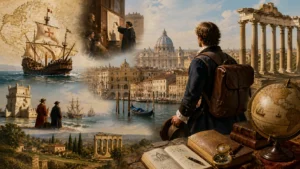
Let us begin, then, by recalling the journey we have already undertaken through more than 4,000 years of history—from the caravans of the earliest merchants during the Neolithic period to the great explorers of the Renaissance and the dawn of the Modern Age.
I promised that I would open this installment by reminiscing about some of those “tourists”—yet unnamed—who were the true precursors of leisure travel, this time by identifying actual historical figures who, through their tales and adventures, etched their names into the annals of history. Let us, then, embark once more upon this journey.

The First Travelers: Before Tourism Existed
Human beings are curious by nature and, consequently, possess an adventurous spirit—one that some develop more fully than others. Let us take an imaginary journey through time, traveling 2,500 years into the past to a small city on the shores of the Mediterranean Sea, located in Asia Minor—in what is present-day Turkey: Halicarnassus.
1. Herodotus: The Man Between Two Worlds
We arrive in Halicarnassus in the year 484 BC. What we find is a small, bustling Mediterranean port—Greek in language and culture—situated on the contested frontier between Greece and its greatest adversary: the mighty Persian Empire, which had incorporated the city into its dominion.
Merchants and sailors from Egypt, Phoenicia, and Asia arrive constantly in Halicarnassus. Let us imagine that setting: a port lacking an identity of its own, dominated by an empire, and teeming with intersecting narratives—conflicting accounts of the known world, which was, at that time, quite small.
It was in this very place that Herodotus—”The Father of History,” whom we have mentioned previously—was born.
Herodotus did not embark on his travels merely out of a desire for adventure but was likely compelled by exile. However, once he had left, his approach to traversing the world was distinct: he did not simply move across territories such as Egypt, Phoenicia, or Asia Minor; rather, he listened to, compared, and gathered diverse accounts of reality, seeking to understand them rather than to impose a single truth.
His origins—situated on a cultural frontier between the Greek and Persian worlds—led him to question everything he saw and heard, thereby transforming travel into a method. He traveled neither as a conqueror nor as a merchant, but as an observer; and within this mode of travel lies a profoundly modern insight: that the world cannot be fully understood from a single vantage point, and that travel can be—above all else—a form of knowledge. That is why Herodotus is much more than the “Father of History”; he is also history’s first “Tourist.”
2. Ibn Battuta: Travel as a System
Ibn Battuta, born in Tangier, Morocco, in 1304, was a traveler who embarked on his adventure at the age of 21 to fulfill two purposes: the first—a religious one—was the Hajj (the sacred duty of every Muslim to undertake a pilgrimage to Mecca at least once in their lifetime); the second was to use his journey as an opportunity to further his legal studies in Egypt and Syria.
That journey, originally intended to last just one year, ultimately evolved into an adventure spanning nearly three decades. Ibn Battuta never ceased his travels, traversing North Africa, the Middle East, Persia, India, Southeast Asia, and China. Amidst this continuous movement, the journey ceased to be merely a moral obligation and transformed into a means of understanding the world.
Ibn Battuta’s significance in this narrative lies not solely in the vast distances he covered, but in the quality of his observations; for Ibn Battuta was no neutral traveler—he moved through the world as a jurist, as a pilgrim, and, at times, as a government official. Yet his accounts reveal something more: he observed, described, and rigorously and precisely compared the systems, customs, and social structures of the places he visited.
His chronicles reveal a privileged witness to a reality that stood in stark contrast to the Europe of his time: while the European continent was passing through what has traditionally been termed the “Medieval Dark Ages,” Asia and the Islamic world boasted remarkably advanced logistical and hospitality systems.
Later in this narrative—when we delve into the subject of accommodation—we will return to Ibn Battuta and his invaluable observations, as recorded in his Rihla (the compiled account of his travels). For now, the lesson Ibn Battuta leaves us with is clear: his accounts are not merely a “travel diary,” but rather a glimpse into how travel functioned in his time. In the Rihla, a system in motion—comprising routes, checkpoints, and networks—emerges with clarity, in which hospitality is not an isolated gesture, but an essential component that made movement possible.
3. Marco Polo: The Invention of the Desire to Travel
We have previously spoken of Marco Polo, born in Venice in 1254. Hailing from a family of merchants, he set out at a very young age alongside his father and uncle toward the East—a journey that would lead him across Asia to what is present-day China, where he arrived at the court of Kublai Khan, the reigning emperor at the time. For years, he was not merely a witness to a distant world, but an inhabitant of it: he traversed territories, observed systems of government, and described cities, markets, and customs with a level of detail unusual for his era.
His account—known as The Travels of Marco Polo—did not merely inform; it captivated. It blended observation with wonder, reality with exaggeration, but above all, it opened a window onto a world that, to Europe, was almost unimaginable. It was neither a technical treatise nor a simple commercial ledger. It was an invitation: for the first time, travel was justified not solely by what it yielded, but by what it revealed.
Travel ceased to be mere movement and transformed into discovery. And within that discovery, something new began to emerge: the desire to see with one’s own eyes those things that others had already recounted.
4. Antonio Pigafetta: The Journey as Memory
Let us recall the voyage of Ferdinand Magellan and Juan Sebastián Elcano—the first circumnavigation of the globe. Accompanying them was Antonio Pigafetta, a Venetian nobleman and a man of humanist education, who embarked on the expedition in 1519—not as an experienced sailor or a merchant, but as a companion and witness. His role was not to command the voyage, but to observe it and chronicle the story of their adventure.
Aboard the expedition, Pigafetta neither commanded nor traded. He observed. He recorded what he saw: peoples, languages, landscapes, gestures. He noted details regarding unknown cultures, described encounters, and interpreted that which he did not understand. His gaze was not fixed on conquest, but on the experience itself.
His account—careful, meticulous, and, at times, surprisingly sensitive—stands as one of the first great testimonies of travel understood as something more than mere physical displacement or a commercial enterprise—which, in reality, was the primary motive for the voyage. With Antonio Pigafetta, the journey is transformed into memory.
And in that gesture—that of recording the world in order to recount it—travel takes a step further: it is not merely lived, but shared. It does not simply happen; it is narrated.
The Anonymous Travelers
Obviously, this story falls short. A great many travelers are missing from it—most of them because they were anonymous adventurers who left no record for history.
To understand this, let us transport ourselves back to 1492, when the world became what we know it to be today. Among the men who crossed the Atlantic with Columbus were travelers of every stripe: those seeking their fortune, those obeying orders, and those charged with the mission of spreading the faith. Yet it is difficult not to imagine—even if he appears nowhere in the records—a different kind of figure: perhaps a cleric, possessing neither rank nor a defined mission, who traveled not to convert souls or to administer affairs, but simply to observe. Someone who gazed out at the horizon with a silent restlessness, listening to the tales of sailors and cartographers with more curiosity than conviction.
There is no evidence that such a person ever existed. Yet his presence feels almost inevitable. For even within history’s most clearly defined undertakings, there is always someone who looks beyond the immediate objective.
With the advent of the Renaissance, the desire to travel became a conscious impulse. Travel began to form an integral part of personal development. Young Europeans roamed the continent to educate themselves—to see, and to understand.
But that is a story for next time!
Bibliography
Parts 1 to 4 — Primary Sources
- Arias, Francisco et al. “El turismo de salud: Conceptualización, historia, desarrollo y estado actual del mercado global” [Health Tourism: Conceptualization, History, Development, and Current State of the Global Market]. Revista Clío América, No. 11, Universidad del Magdalena.
- Leed, Eric J. The Mind of the Traveler: From Gilgamesh to Global Tourism. New York: Basic Books, 1991.
- Feifer, Maxine. Tourism in History: From Imperial Rome to the Present. New York: Stein and Day, 1986.
- Buzard, James. The Beaten Track: European Tourism, Literature, and the Ways to Culture, 1800–1918. Oxford: Clarendon Press, 1993.
- Withey, Lynne. Grand Tours and Cook’s Tours: A History of Leisure Travel, 1750–1915. New York: William Morrow, 1997.
- Hibbert, Christopher. The Grand Tour. London: Weidenfeld & Nicolson, 1969.
Institutional Sources
- World Tourism Organization (UNWTO). Glossary of Tourism Terms. unwto.org
Historical and Literary Sources
- Herodotus. Histories.
General Reference Sources
- Encyclopaedia Britannica. Articles on the history of tourism, the Roman Empire, the Middle Ages, and the Renaissance. britannica.com
- History.com. Articles on ancient history, the Middle Ages, and European expansion. history.com
Methodological Note: This document is based on a synthesis of academic, institutional, and historical popularization sources, cross-referenced to ensure narrative coherence and conceptual accuracy. Given its editorial nature, some interpretations integrate multiple references into a single line of argument. For academic use, it is recommended to consult the cited primary sources directly.