The Hotel Industry: an exciting story
THE STORY OF TRAVEL CONTINUES
By: Jorge Alberto Escobar de la Cuesta
PART 6
THE GRAND TOUR, ROMANTIC TRAVELERS, AND THE FIRST LUXURY HOTELS
Here we are again. In the previous story, we followed some travelers who left an indelible mark across the long span from Antiquity to the Renaissance — the forerunners of modern tourism, even though that term was still unknown. Travelers for whom it was not so much the destination that mattered, but the journey itself: discovering new regions, cultures, customs, and wonders.
We now enter the seventeenth century. The great discoveries had vastly expanded the boundaries of the narrow medieval world, and the planet was, for the first time, almost completely known.
That “almost” has a story of its own.
To arrive here, humanity had traveled a winding road. During the millennium before the fall of Rome, thinkers such as Pythagoras, Aristotle, Euclid, and Galen had laid the foundations of mathematics, philosophy, medicine, and astronomy. But that inheritance began to fade with the disintegration of the Roman Empire: the fragmentation of power in the West was also a fragmentation of knowledge, and so the Middle Ages were born — nearly a thousand years of obscurantism.
Yet that knowledge did not disappear entirely. In Baghdad and throughout the Islamic world, it was gathered, preserved, and in many cases expanded. Figures such as Ibn Sina (Avicenna), a Persian physician and philosopher and author of the Canon of Medicine, consolidated this legacy in works that synthesized the Greek tradition with their own contributions.
With the expansion of Islam and its presence on the Iberian Peninsula, that knowledge reached the West: in al-Andalus — Córdoba, Seville, Granada, and Toledo — great intellectual centers flourished where it was studied and reinterpreted, as demonstrated by the work of Averroes, a Cordovan philosopher and physician celebrated for his commentaries on Aristotle.
Although part of this heritage was lost during the conflicts of the Reconquista, a substantial portion was recovered through the work of European translators who accessed these sources in Arabic. Among the most notable were Gerard of Cremona, who translated Ptolemy’s Almagest and many other scientific treatises into Latin in Toledo, and Adelard of Bath, an English pioneer who, after traveling through the Islamic world, introduced mathematical texts such as those of Euclid into Europe.
In this way, Europe began to reclaim — largely through the Islamic world — the intellectual heritage it had lost centuries before.
The Renaissance was born from that rediscovery of knowledge. And with it came a new map of power: no longer that of feudal lords wielding authority from their castles in isolated territories, but that of emerging kingdoms — France, Castile, Aragon, the Habsburgs, nascent England, and the league of northern principalities (what is today Germany).
In the as-yet nonexistent Italy — for Italy is in fact a young country, unified only in the nineteenth century — certain cities stood out as powers in their own right, such as Venice and Genoa, whose strength rested on commerce and maritime trade routes.
But the true center of gravity of the West remained Rome — the eternal Rome: from the Vatican, the Pope not only exercised spiritual authority but exerted a decisive influence on the political balances of the era, intervening in coronations, legitimizing kingdoms, and shaping the power of monarchs and princes.
On that chessboard there emerged, in the westernmost corner of Europe, a small kingdom that was about to change the world: Portugal. Hemmed in by Castile and with no outlet by land, it turned almost by necessity toward the sea. First it explored the Atlantic islands. Then it progressively traced the African coastline until, at the end of the fifteenth century, it reached the sea route to the East — consolidated by the voyages of Vasco da Gama — and with it, transformed itself into an empire of global scale.
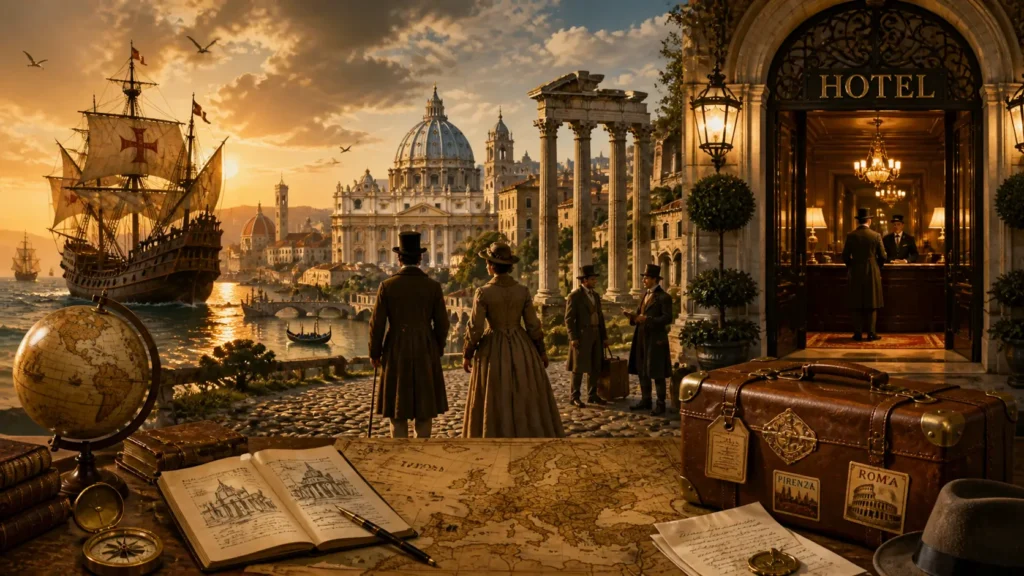
What Portugal set in motion, Spain multiplied. The voyage of 1492 did not merely reveal new territories: it transformed the very perception of the world. Suddenly, the known horizon expanded radically. And with that expanded world came wealth, spices, raw materials, and above all, ideas. The exchange between continents accelerated the pulse of knowledge as never before.
In what we have already established as Italy, that pulse had been beating powerfully for decades. The Renaissance had restored the human being to the center of the universe — after centuries in which order was explained primarily through the divine — and with it flourished art, architecture, science, and literature with unprecedented intensity. Rome, Florence, Venice: cities that were, at one and the same time, laboratories of thought and open-air museums. All of Europe looked toward Italy as one looks toward the source.
But it was in those northern principalities we mentioned earlier that this impulse found one of its most disruptive expressions. The Protestant Reformation, launched by Martin Luther in 1517, shattered the religious unity of the West and, with it, the unquestioned authority of Rome.
England, which had broken with the papacy under Henry VIII, emerged from that process as a new power — more pragmatic, more commercial, more curious — with an elite that was beginning to ask itself how to educate its heirs in a world that now surpassed the limits of an island.
The answer, as we shall see, was to send them to travel the Continent.
That was the world that made the Grand Tour possible.
I. The Grand Tour: When Travel was an Art
It was the seventeenth century, and in England of the time there was a deep conviction among aristocratic families: a young gentleman was not truly educated until he had traveled Europe. The finest schools and libraries full of books were not enough. There was knowledge that could only be acquired in the field — standing before the ruins of the Colosseum, in the salons of Versailles, contemplating Michelangelo’s David in Florence, or debating philosophy in the coffeehouses of Paris.
The English, even amid their rivalry with France, have always looked toward that country as a reference point for culture and distinction. And so this “rite of initiation” came to be called the Grand Tour — borrowed from the French “le grand tour” (the great circuit) — in reference to the journey that had to be undertaken, and which for more than two centuries became the hallmark of those who aspired to be someone in Europe.
The typical route departed from London, crossed the English Channel toward France — with Paris as the obligatory first stop, naturally — continued through the Swiss Alps, descended to the Italian cities of Turin, Genoa, Florence, Rome, and Naples, and in some cases extended as far as Greece or the eastern Mediterranean. The journey could last anywhere from several months to years. If today we complain about younger generations wanting to spend their time traveling, our ancestors were no different.
But a young man of seventeen or eighteen did not embark on such an adventure alone. The great British families organized the Grand Tour with a meticulousness worthy of a military operation. The central figure was the tutor — known at the time as the Bear-leader, literally “the one who leads the bear” — a title that tells us everything we need to know about how these young nobles were perceived: full of energy and potential, but perfectly capable of ruining everything if left unsupervised.
These tutors were not mere companions. They were men of high intellectual formation — clergymen, university professors, distinguished academics — hired to oversee every aspect of the young man’s education throughout the journey. They ensured he visited the proper monuments, attended the most reputable academies of art, learned French and Italian — the languages of culture and diplomacy at the time — and associated with the right people in each city.
But they also — and this was equally important to the families — watched over the young man to ensure he did not squander the family fortune on the many vices that European cities had to offer. Rome, Naples, and Venice were celebrated as much for their artistic treasures as for their temptations. An experienced tutor knew perfectly well when his pupil needed culture and when he needed someone to discreetly steer him away from a gambling table or unsuitable company. He was, at bottom, a blend of professor, nanny, and public relations agent.
The retinue was not limited to the young man and his tutor. The most powerful families also sent a retinue of servants, a secretary to manage correspondence and finances, and in some cases even a physician. Travel, for the British aristocracy of the seventeenth and eighteenth centuries, was a major family undertaking — an investment in the future, political, social, and cultural, of whoever would one day inherit titles, lands, and responsibilities of state. In theory it was not a holiday: it was an education. Though in most cases, they had a wonderful time.
They also traveled with letters of introduction signed by the most influential families in England, addressed to their counterparts in Paris, Rome, or Florence. Those letters opened doors that money alone could not: private salons, audiences with cardinals and princes, access to art collections that were not open to the public, dinners with the most distinguished intellectuals and artists of the age. The Grand Tour was, in that sense, also a way of forging alliances and friendships that would last a lifetime.
The relationship between the young aristocrat and his tutor was, in many cases, profoundly formative for both. Adam Smith — the father of modern economics — served as tutor to the son of a British aristocrat,¹ on a journey from 1764 to 1766. An experience that would directly influence the ideas he would later set down in The Wealth of Nations. His masterwork.
Adam Smith — the father of modern economics — served as tutor to the son of a British aristocrat[1] on a journey from 1764 to 1766. An experience that would directly influence the ideas he would later set down in The Wealth of Nations. His masterwork.
And upon returning, the transformed young man — more cultured, more multilingual, more self-assured, with the experience of having seen the world — was ready to assume his place in society. The Grand Tour was not a luxury. It was, for the great families of Britain, an indispensable investment in the formation of character and leadership.
The Grand Tour was not the exclusive province of England. Powerful German nobles and merchants soon learned from the English example and began traversing Europe with equal enthusiasm. Among the most celebrated grand tourists in history are the writer James Boswell, the poet Lord Byron, the philosopher John Locke, and the writer and playwright Johann Wolfgang von Goethe, whose Italian Journey would become one of the most influential travel books in Western history. Goethe arrived in Rome in 1786 and wrote that he had at last reached the capital of the world. For him, as for so many others, Italy was not a destination: it was a revelation.
As I imagine you have already guessed, from all of this we can easily deduce where the word “tourist” comes from.
II. The Romantic Travelers: When the Heart Took Command
The Grand Tour was the forerunner of a new way of traveling. It was no longer simply a matter of trading, exploring territories, or taking part in the frequent wars of the era. Gradually, the value of travel began to shift toward the experience itself. The Greek poet Constantine P. Cavafy expressed it with clarity in his work Ithaka: “Keep Ithaka always in your mind. Arriving there is what you’re destined for. But do not hurry the journey at all…”
In the eighteenth century we enter fully into a new era: the Industrial Revolution. The expansion of production transformed Europe profoundly and, in many cases, unexpectedly. In regions of the north, the growth of industrial activity came with an evident cost: the transformation of landscapes that had remained almost untouched for centuries, the intensification of mining, and the displacement of large rural populations toward the new urban centers in search of work. Chimneys began to replace forests, and the noise of machines broke through the silent valleys of former times. At the same time, cities grew rapidly and without planning, giving rise to dense, grey environments ever more removed from the natural world they had replaced.
In the midst of a world modernizing and changing at a dizzying pace, there arose a powerful nostalgia for the past — a longing for authenticity and for the nature that was beginning to dissolve in the relentless drive toward production. Faced with the noise, speed, and uniformity of the new industrial life, some began to look in the opposite direction: toward unspoiled landscapes, local traditions, and places where time seemed to pass differently.
From that reaction a new way of traveling was born. It was no longer merely a matter of moving out of necessity or convenience, but of seeking a different experience: to contemplate, to feel, to reconnect. And so the Romantic Traveler emerged.
Unlike the aristocrats who embarked on the Grand Tour, whose primary aim was intellectual formation, the Romantic travelers journeyed in order to feel. More than lessons in history, they wandered the ruins of Rome and Greece as an almost spiritual experience. They lost themselves in the landscapes of the Alps, not for investigative purposes, but to be overwhelmed by their peace and beauty. They traveled south to Europe or to the Middle East seeking what the industrialized north could not offer them: color, authenticity, rusticity, and passion. The Romantic Travelers had a single purpose: to let themselves be affected by what they encountered along the way.
Andalusia, in southern Spain, became without question a landmark for Romantic travelers. The American writer Washington Irving arrived in Granada in 1829, a city that had been the last stronghold of the Muslim world on the peninsula. At that time, the Alhambra — more than a palace, the magnificent seat of power of the ancient Nasrid kingdom — lay half-abandoned, somewhere between ruin and oblivion. Irving decided to stay. For months he lived within its spaces and wrote his most celebrated work, Tales of the Alhambra, in which he not only described the place but reinvented it, helping to construct the Romantic image of Andalusia.
Something similar was happening elsewhere in Spain. Almost concurrently, the English traveler and writer Richard Ford traveled the country on horseback, without haste, and published in 1844 his Handbook for Travellers in Spain, one of the first modern travel guides.
At the same time, another Englishman, George Borrow, arrived with a different purpose: to distribute Bibles in Spanish. That objective led him to travel the country in precarious conditions, crossing cities and roads from a much more direct vantage point. From that journey was born The Bible in Spain (1843), a book that is not religious but rather a social chronicle of extraordinary value, in which he portrays the Spain of his time with frankness and without embellishment.
Unlike Ford, Borrow does not merely describe the country: he inhabits it. And in that closeness, he manages to portray it with an authenticity rarely found among the travelers of his era.
And then there was Ronda. Suspended above its own abyss, with its new bridge defying the void, its bullfighting tradition, and a breathtaking landscape that seemed to resist the passage of time, the city became an inevitable destination for those seeking something more than a place. In the twentieth century, Ernest Hemingway and Orson Welles would find there that same magnetism and would help fix, once and for all, its image as an intense, timeless, and profoundly Romantic city.
The consequence of all this was extraordinary. The accounts of these travelers reached the public and awakened a new desire: to live in person what had been narrated. Without intending to — or perhaps not entirely — the Romantics turned the travel narrative into the true engine of the journey. For the first time, one did not travel simply to arrive, but to experience what others had described.
The narrative became the engine of tourism: travel ceased to be born of necessity and began to be born of desire.
It is time to pause in our journey and consider the evolution of lodging, from Antiquity to the eighteenth century. In the next writings, we will open a parenthesis to weave the world of hospitality into the historical thread we have traced.
[1]Although the character in question is not relevant to this story, for the curious among you, it was the Duke of Buccleuch—who, incidentally, was notable only for the prominence of his tutor.