The story of travel continues
By: Jorge Alberto Escobar de la Cuesta
In the previous article, we saw how the Grand Tour and the Romantic travelers permanently transformed the motivation behind travel, and how lodging infrastructure was beginning —still timidly— to respond to that new demand. But all of that remained a phenomenon limited to minorities: wealthy aristocrats, idealistic adventurers, merchants, or diplomats.
Something was about to happen that would change everything: steam would transform the way people traveled.
The railway: the beginning of modern travel
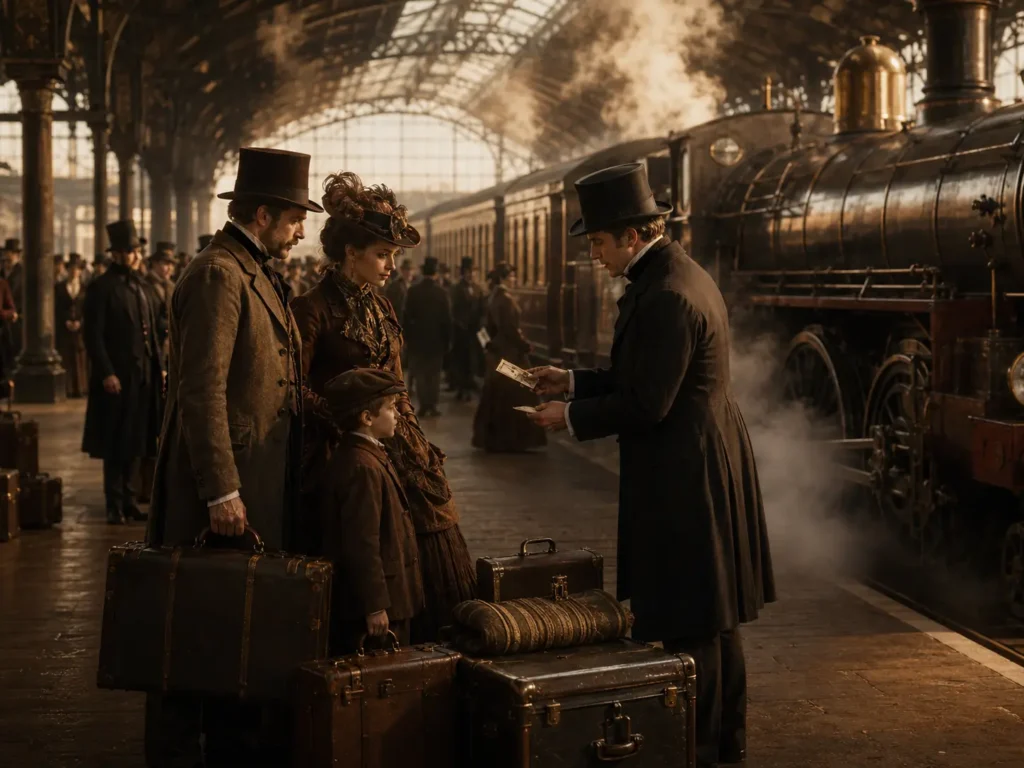
That change wasn’t merely technical. With steam, trains began running fixed routes at constant speeds, carrying hundreds of people on each trip. Distances shrank, travel time dropped dramatically, and for the first time, getting somewhere stopped depending on chance and began following fixed schedules.
And once time stopped being uncertain, travel could be organized.
Steam at sea: when the journey crossed oceans
But the change didn’t happen only on land.
At the same time, steamships were beginning to transform sea travel. Transatlantic routes, which for centuries had been long and unpredictable, started operating with schedules, frequencies, and a regularity unimaginable until then. Crossing the ocean stopped being an unpredictable crossing and became a journey with defined itineraries.
And not only that. Those ships were not simple means of transport. They were, in many ways, floating hotels: they offered cabins, lounges, dining rooms, and a social life that accompanied the journey for days or weeks.
For the first time, movement and stay began to blur together. The journey was no longer just about arriving at a destination, but about inhabiting the trip itself.
Thomas Cook: when travel became organized
It was precisely in that new context —where travel was starting to be fast, predictable, and above all, plannable— that a key figure emerged.
On July 5, 1841, a 32-year-old carpenter and Baptist preacher walked from his home in Market Harborough to Leicester, England, to attend a meeting of the Temperance Society —the Christian movement that promoted abstention from alcohol—. As he covered the fifteen kilometers between the two towns, he had a brilliant idea.
His name was Thomas Cook. And what he grasped was this: that the railway, the new technology transforming transportation, could serve not only to move people, but to organize entire trips.
That same year, he persuaded the Midland Counties Railway company to charter a special train between Leicester and Loughborough. On that first excursion, 485 people traveled for the price of a shilling —a modest sum for the time— which included the trip, a meal, and the services of a music band. This has been described as the world’s first package tour.
Cook made no profit from that initiative. But he understood he had discovered something new. In 1855 he organized his first trip abroad, a tour through Belgium, Germany, and France. In 1868 he introduced “hotel coupons,” certificates redeemable for lodging and meals at partner establishments. In 1874 he developed the traveler’s check: a document that allowed people to carry money safely and use it in different countries without needing cash.
Without meaning to, he had set something much larger in motion: the organized tourism industry. The company born from that idea operated for more than a century, until it disappeared in 2019, when the world of travel had changed so much that even its own business model had practically ceased to exist.
What Thomas Cook understood before anyone else was that traveling didn’t have to be a privilege reserved for aristocrats with tutors and letters of introduction. With the railway as a tool and the right organization, travel began opening up to far more people.
But this new kind of travel brought with it a different requirement: not just getting somewhere but having somewhere to arrive.
The old inns were no longer enough. Lodging had to change.
Boston, 1829: The World’s First Modern Hotel
That change didn’t happen in Europe, but on the other side of the Atlantic.
In the early decades of the 19th century, the United States was growing at a different pace: expanding cities, dynamic commerce, and a steady flow of travelers that no longer let up. Hospitality stopped being occasional and began becoming a permanent need.
In that context —not by chance, but as a response to that new flow— the Tremont House opened its doors in Boston in 1829. At first glance it might have looked like just another building. But in reality, it was something completely different: a place conceived from the start to house travelers.
Until then, most establishments were adaptations: private homes converted into inns, repurposed buildings, spaces originally designed for other purposes. The Tremont House broke with that logic. It wasn’t an adaptation. It was a project driven by local businessmen, designed from the ground up by architects and engineers with one specific idea: to create a modern establishment for travelers.
For the first time, lodging brought together a set of elements we now take for granted: private rooms with locks, well-defined common areas, organized staff, and a centralized front desk. It even incorporated innovations uncommon for the era, such as gas lighting and a bell system that let guests call for attention from their rooms.
But what truly mattered wasn’t in the technical details —it was in the idea behind them: the traveler stopped being an occasional guest and became the center of the system.
The modern hotel had just been born. But this new model didn’t follow a single path. In the United States it had emerged as a practical response to a concrete need. In Europe, however, it was about to become something more: not just a place to stay, but a stage where travel took on another dimension.
That’s where the idea took its next step.
Ritz & Escoffier: When hotels learned to seduce
After the Tremont House, the modern hotel already had a shape: private rooms, organized services, a front desk, security, and a clear operating logic. But something was still missing. The hotel could be efficient, comfortable, and modern… but it wasn’t yet, necessarily, an experience.
That leap would be taken by two men who understood luxury from different but complementary angles: César Ritz and Auguste Escoffier.
César Ritz was not born among grand hotels or surrounded by luxury. He was born in 1850 in Niederwald, a small village in the canton of Valais, Switzerland, the youngest of thirteen children in a peasant family. At fifteen he got a job as a sommelier’s apprentice at a hotel in Brig, in the Swiss Alps, and it was there that he began to discover the talent that would make him famous: an almost instinctive ability to understand guests and anticipate their needs before they even voiced them.
Auguste Escoffier, for his part, came from another world: the kitchen. Born in the French Provence region and trained in its extraordinary culinary tradition, he understood that feeding the traveler wasn’t just a necessity but an opportunity to elevate the entire hotel experience. While Ritz revolutionized service, Escoffier turned the kitchen into a rigorous organization capable of delivering the same quality time after time.
By the end of the 19th century, the world of luxury was changing. The aristocracy was no longer the only protagonist. Around it, a new elite was emerging: industrialists, bankers, artists, international travelers. People with money and a clear expectation: they didn’t just want good lodging. They wanted to be attended to with elegance, discretion, and precision.
In 1889, Ritz and Escoffier took over management of the Savoy Hotel in London, a name that will reappear later in this story. Under their direction, the establishment achieved near-immediate success and began offering amenities still uncommon at the time, such as electric lighting, elevators, marble bathrooms, and hot water available at all hours. Yet the true transformation wasn’t only in these advances. Ritz changed the way guests were welcomed; Escoffier changed the way they were seated at the table.
At the Savoy, something happened that seems normal to us today but was revolutionary then. Dining at the hotel stopped being a simple complement to lodging and became an experience itself. While Ritz made guests feel important from the moment they arrived, Escoffier ensured the table matched the same standard as the rest of the service.
In 1897, just when they seemed to have reached the top, something unexpected happened. Ritz and Escoffier were removed from the Savoy following a dispute with the hotel’s management over purchasing and commissions —an episode that caused great controversy at the time. However, that setback was far from ending either man’s career.
Far from separating them, that crisis ended up strengthening them. Barely a year later they joined talents again to make César Ritz’s most ambitious project a reality: the Hôtel Ritz Paris, opened on June 1, 1898, on the elegant Place Vendôme. While Ritz conceived a new way of welcoming guests, Escoffier raised the hotel’s kitchen to a level never seen before, cementing a partnership that would forever mark the history of hospitality and gastronomy.
Everything in the new Ritz reflected that shared vision. While many hotels still treated certain amenities as exceptional, this establishment offered a private bathroom, electricity, and a telephone in every room. But the real innovation went well beyond technology. Ritz had understood that luxury wasn’t measured by ostentation, but by how guests felt from the moment they walked through the door, while Escoffier demonstrated that great cuisine alone could be a reason to choose a hotel.
Over the years, its salons and rooms would welcome some of the most important figures of the era, among them Marcel Proust, Ernest Hemingway, and Coco Chanel, cementing a reputation that keeps it among the world’s most iconic hotels.
It was King Edward VII of England himself who dubbed Ritz “the hotelier of kings and the king of hoteliers.” But beyond that recognition, Ritz did something far more important: he changed forever the way luxury was understood. He grasped that it wasn’t found solely in visible opulence, but in that almost imperceptible attentiveness that made guests feel important at every moment of their stay.
Together with Escoffier, who brought hotel cuisine to a level of excellence never seen before, he made the hotel stop being simply a place to spend the night. From then on, staying at a hotel meant living an experience in which service, gastronomy, and atmosphere were part of a single concept of hospitality.
Even so, that world remained reserved for a privileged few. The 20th century was about to change that reality and open the door to a new way of traveling and of understanding hospitality. But that’s a story that deserves its own chapter.