The story of travel continues
By: Jorge Alberto Escobar de la Cuesta
PART 8
From Hospitality to Hotel: The Birth of an Industry
For centuries, hospitality had been a duty—religious, social, or political—more than a service designed to please the traveler. But something was beginning to change: it was also starting to consolidate as an economic activity.
As travel became a more frequent and differently natured activity, so too did the place where one slept. The traveler was no longer merely a pilgrim or an official. Increasingly, the traveler was someone who chose to travel and was willing to pay for the experience. With that choice came new expectations.
It was no longer enough to host, one had to host better. It was not an abrupt change, but a gradual transformation. In some parts of Europe, establishments began to appear that no longer responded solely to the need to provide lodging, but also to the desire to attend to the guest more thoughtfully.
1. Germany: The Red Bear of Freiburg
In Germany, one of the first establishments that we can today recognize as a direct forerunner of the hotel in Europe had existed since the twelfth century: the Zum Roten Bären—“The Red Bear”—in the city of Freiburg im Breisgau, in the heart of the Black Forest.
Unlike the more rudimentary inns of its time—where lodging was improvised, shared, and often precarious—something different was beginning to take shape here: a place that operated continuously, with defined spaces for rest, dining, and stabling, and regular attention for the passing traveler.
Its history predates even the founding of the city of Freiburg in 1120, and the earliest written records documenting its activity as an inn date from 1387. Over the centuries, it survived the Black Death, the religious wars of the seventeenth century, the Rhine campaign of 1713—which destroyed the original building—and two world wars.
According to local tradition, Marie Antoinette lodged here with her retinue in 1770, on her way to Versailles to marry the future Louis XVI.
Today it continues to welcome guests, with its medieval vaults intact in the cellar and the golden red bear still visible on the façade.
It is not merely its antiquity that makes it significant. In places such as this, something new begins to take shape: accommodation ceases to be an occasional solution and becomes a stable, recognizable activity oriented toward the traveler.
2. Italy: The Florentine Palaces
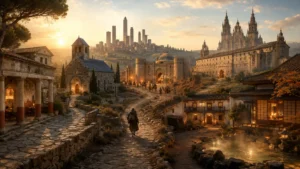
In Italy, an indispensable destination on the Grand Tour, Florence occupied a central place. It was not merely one more city in the itinerary: it was the place where the traveler came face to face, perhaps for the first time, with the very idea of civilization understood as art, proportion, and beauty in their purest form. Florence stood Brunelleschi, Michelangelo, Botticelli; a city where the Renaissance had been born. For many, arriving in Florence was not part of the journey. It was the journey.
The Florentines quickly grasped the change that was taking place. Facing that new type of traveler—more demanding, more affluent—they responded by transforming their own palaces. Many Renaissance residences began to be adapted as lodging houses, offering not only accommodation but a level of comfort and distinction befitting those who arrived.
By the late eighteenth century, guides written specifically for Grand Tour travelers had begun to circulate, recommending the best accommodation in the city, and singling out those that offered “apartments in the Parisian style.” It was a clear signal that comfort, taste, and the comparison of options were beginning to form part of the journey itself.
Florence is home to the Locanda Porta Rossa, first documented in 1386 and housed in a building that incorporates a thirteenth-century tower. Considered one of the oldest hotels in Italy, it remains in operation today, woven into the history of the city.
In places like this, accommodation ceases to be a necessity and begins to become an extension of the journey itself.
3. England: The Coaching Inns
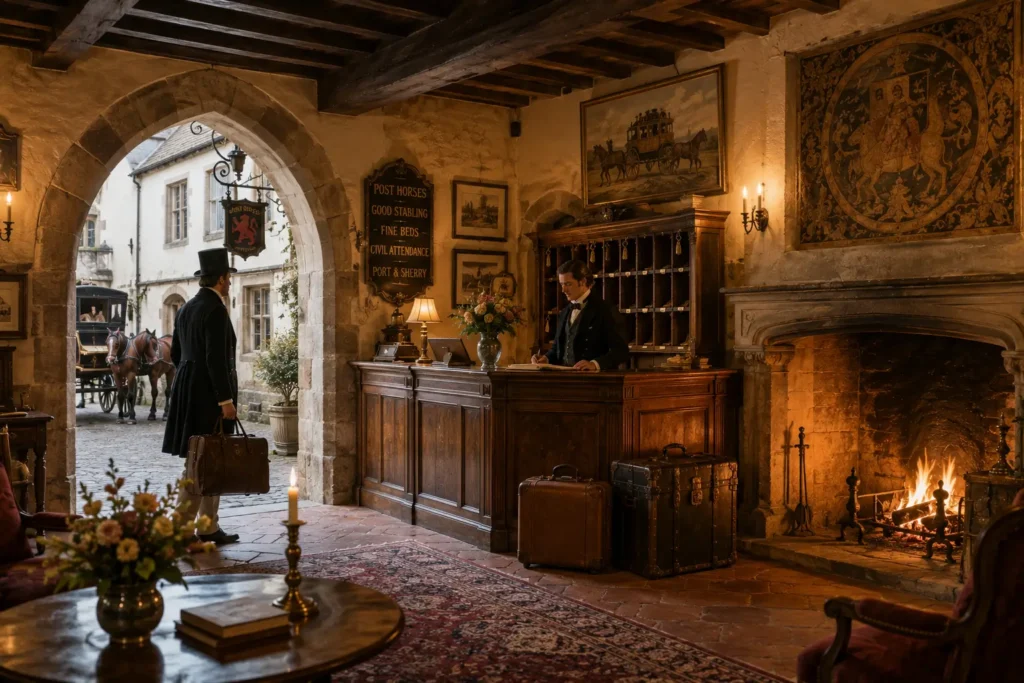
In England, the coaching inns flourished: inns located strategically along stagecoach routes where travelers could rest, change horses, and take a hot meal on the way. Some reached a notable level of sophistication, with private rooms, well-attended dining rooms, and first-class stables.
They were the direct ancestors of the modern hotel in the English-speaking world, and many of them still survive as historic pubs with rooms, witnesses to centuries of British hospitality.
But their true importance lies not only in their form, but in what they reveal. In the same period in which the traveler was ceasing to be a pilgrim and becoming an aristocrat in training—and later a traveler in search of experience—accommodation evolved alongside: from the shared pallet to the private room, from the rudimentary inn to the urban palace.
The two threads—that of the traveler and that of the host—advanced in parallel, pushing each other toward ever more complex forms of hospitality. The ancient relationship of hospes, which had bound the one who receives and the one who is received, was beginning to take shape as a system: what had once been welcome was becoming, little by little, service.
4. France: The Birth of the Modern Hotel
If Germany shows continuity, Florence shows transformation, and England shows the organization of travel, it is in France that accommodation takes its decisive step.
In France, the term hôtel—also derived from the Latin hospes—began to shift in meaning during the seventeenth century. Originally it designated the grand urban residences of the nobility, but these houses, conceived to welcome the court, guests, and delegations, also began to open their doors to high-ranking travelers.
Over time, the term ceased to refer only to private residences and came to be applied to establishments offering quality lodging to distinguished guests.
There the shift occurs. The ancient relationship of hospes ceases to be confined to the domestic sphere and begins to be organized as a service: what had previously been welcome becomes professional hospitality.
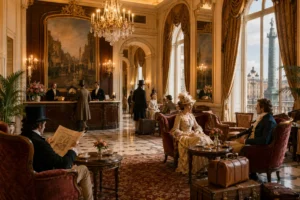
This change was not merely linguistic but cultural. In 1758, Louis XV promoted the construction of two grand palaces on the Place de la Concorde, as part of the complex designed by the royal architect Ange-Jacques Gabriel. These buildings, conceived to lodge ambassadors and representatives of other courts, brought together hospitality, architecture, and the representation of the State.
In time, one of them passed into the hands of the Crillon family and, in 1909, was transformed into the Hôtel de Crillon. The Hôtel de Crillon embodies that transition: from aristocratic residence to modern luxury hotel, a space conceived not only to lodge, but to represent, to receive, and to project prestige.
Here the change is unmistakable. For the first time, three elements come together that had not previously coincided in so clear a way: intentional design, organized service, and guest expectations.
It is at this point that the hotel, as we understand it today, begins to take recognizable shape.
Until next week!