The story of travel continues
By: Jorge Alberto Escobar de la Cuesta
In the previous article, we saw how hospitality took one of the most important steps in its history. The hotel stopped being simply a place where travelers found a bed and a roof, and it became an experience.
Thanks to César Ritz and Auguste Escoffier, service reached a level of refinement never known before, and fine cuisine became an essential part of hospitality. Luxury was no longer measured only by the grandeur of the building, but by the way guests were welcomed, cared for, and surprised.
But that transformation was only just beginning.
If Boston’s Tremont House had defined the structure of the modern hotel, and London’s Savoy had shown everything this new form of hospitality could become, the next step was to bring that idea to the great capitals and the world’s main travel routes.
That’s when hotels appeared that didn’t just house travelers, but ended up becoming stages of history, refuges for artists, meeting points for diplomats, inspiration for writers, and symbols of an era in which travel was starting to change forever.
Some of those hotels are still open more than a century later. Others disappeared over time. But all of them left a deep mark on the history of hospitality. In this installment, we’ll tour some of the most iconic.
1. Paris: the capital of the grand hotel
No city embodied the concept of the grand hotel in the 19th century better than Paris.
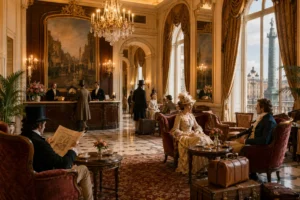
The first to stand out was Le Meurice. It had been created with English travelers in mind, those crossing the Channel to discover Europe, but it ended up occupying one of the most privileged spots in Paris, facing the Tuileries Gardens.
Over time, it stopped being a mere stopover. It became a residence for artists and a refuge for figures who shaped its history.
In August 1944, as Allied troops advanced on Paris, German general Dietrich von Choltitz set up his command post there. From those rooms he received the order to destroy the city before withdrawing. He disobeyed it, and Paris remained standing.
A few streets away, the Grand Hôtel opened its doors in 1862. It was an enormous building for its time: hundreds of rooms, monumental salons, and on its ground floor, opening onto the street, the Café de la Paix, which very quickly stopped being just the hotel’s café and became one of Parisian society’s favorite spots.
Artists, politicians, writers, and travelers gathered there. You didn’t need to stay at the hotel to be part of that world. It was enough to sit at a table and claim a place in the life of the city.
The hotel stopped being a place of passage and became the point where the city met itself.
2. The Savoy, London: the hotel that changed English social life
The Savoy wasn’t new to this story.
Across the Channel, theatrical entrepreneur and producer Richard D’Oyly Carte had conceived the Savoy inspired by the modernity of American hotels, but it was there that model found a distinct life of its own.
Under the direction of César Ritz and Auguste Escoffier, as we saw earlier in this story, the Savoy became legendary.
In its kitchens, Escoffier shaped a new way of understanding gastronomy, creating dishes that transcended the hotel and became part of culinary culture, such as the Pêche Melba and Melba toast, created in honor of the Australian soprano Nellie Melba.
Its impact, however, went beyond what it served. Unlike Paris, where the hotel opened out to the city, at the Savoy the hotel became a space where society performed itself.
People didn’t go there only to stay, but to be seen and to take part in a carefully constructed scene, where the space, the service, and the protocol favored that exposure.
Even the act of dining in public —especially for women— became a new normal there.
The Savoy established something different: the hotel as a stage for social life.
3. Venice: history becomes lodging
Not all the grand hotels of the 19th century were born of modernity. In Venice, quite the opposite happened.
There, some of the most famous hotels were, in fact, former palaces that had simply changed function. The best example was the Gritti Palace.
The building had, centuries earlier, been the residence of Doge Andrea Gritti, one of the most distinguished rulers of the Republic of Venice.
Over time, the palace stopped being a center of power and, well into the 19th century, was adapted to receive travelers. It wasn’t born a hotel: it ended up becoming one. Its spaces were reorganized, its interiors adapted, but its character remained intact.
Those who stayed there didn’t enter a modern building, but a place steeped in memory, where the architecture, materials, and layout of the spaces still carried visible traces of its past.
Generations of travelers passed through its rooms —artists, writers, keen observers— who found in Venice something more than a destination.
The Gritti isn’t a hotel that has history: it is history that has rooms.
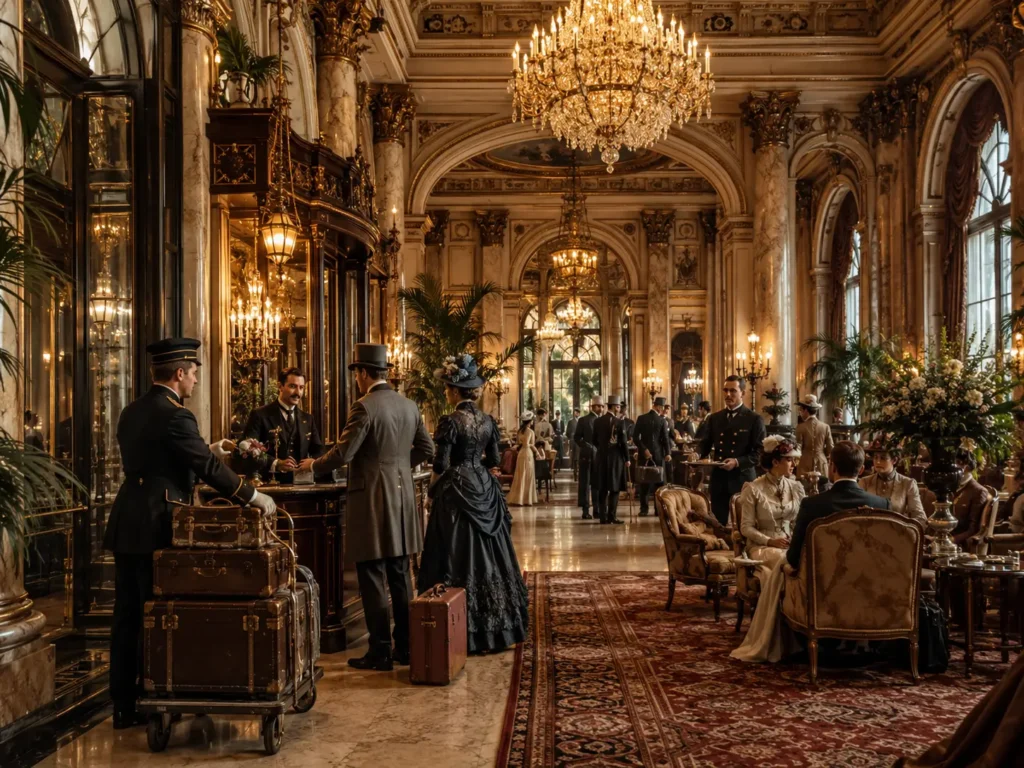
4. The Pera Palace, Istanbul: the hotel at the end of the journey
In 1883, something extraordinary happened. For the first time, it was possible to board a train in Paris and, days later, get off in Constantinople after covering more than three thousand kilometers.
It was called the Orient Express, and it became the most famous journey in the world.
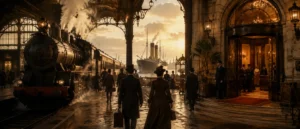
Its carriages offered private compartments, elegant dining cars, round-the-clock service, heating, refined meals, and a level of comfort unknown until then on such a long trip.
By the late 19th century, sleeping on the Orient Express was about as close as one could get to staying at a luxury hotel… only on rails.
The final destination was Constantinople, present-day Istanbul, a city that for centuries had been the capital of great empires and remained the meeting point between East and West. There, Europe seemed to reach its limit.
But when passengers arrived at the end of the line, they found an unexpected problem. They had traveled with a level of luxury and comfort never seen before, yet Constantinople still didn’t have a hotel capable of welcoming them to that same standard.
The Pera Palace Hotel was the answer. Opened in 1892 by the same company that operated the train, it was designed to offer in Constantinople the same level of comfort travelers had enjoyed during the journey.
It wasn’t just about building a good hotel. The idea was that the Orient Express experience shouldn’t end when passengers stepped off the train. That same level of comfort, elegance, and service had to extend all the way to the guest room.
To achieve this, the Pera Palace featured private rooms, modern amenities, and spaces designed for the international traveler, without losing the character of a city that had spent centuries as the bridge between two worlds.
The Orient Express ended at the station. The travel experience, however, continued at the Pera Palace.
5. Shepheard’s, Cairo: the hotel of power
If there was a hotel where half the British Empire seemed to gather, it was Shepheard’s in Cairo.
Founded in 1841 by Samuel Shepheard, a British businessman who recognized the city’s enormous potential, the hotel occupied a building that years earlier had served as barracks during Napoleon’s campaign.
Very early on, it stopped being a simple lodging place. Anyone who wanted to understand what was happening in Egypt sooner or later ended up passing through Shepheard’s.
It was no coincidence. In 1869 the Suez Canal opened, and the map of the world changed forever.
The new waterway connected the Mediterranean with the Red Sea and drastically cut travel time between Europe and Asia. Egypt gained a strategic position, and Cairo became a mandatory stop for diplomats, merchants, soldiers, and explorers.
Shepheard’s fit right into that new scene. It wasn’t a closed, quiet building, but an open hotel, with wide terraces and salons where life played out facing outward.
More than privacy, it offered presence: there, one saw and was seen.
At any hour of the day, one could find on its terraces a diplomat freshly arrived from London, an archaeologist preparing an expedition to the Valley of the Kings, a British officer on his way to Sudan, or a merchant who had just crossed the Suez Canal.
Shepheard’s was much more than a hotel: it was the crossroads for the people who, one way or another, were writing the history of the Middle East.
For decades it was one of the most famous hotels in the world, comparable in prestige to the Ritz in Paris or the Savoy in London.
But no symbol lasts forever. In 1952, during the unrest that marked the end of British influence in Egypt, Shepheard’s was consumed by fire.
With it disappeared not just one of the world’s most famous hotels, but also an era in which great empires seemed to govern from the salons of hotels like that one.
6. Raffles, Singapore: the empire relocated
If Shepheard’s was the hotel of power, Raffles offered something different: the feeling of still being in Europe, even though the traveler was thousands of kilometers away from it.
Founded in 1887 by the Sarkies brothers, Armenian-descended hoteliers established in Southeast Asia, the hotel was born in exactly the right place at the right time.
By the late 19th century, Singapore was one of the world’s most important ports. Ships bound from Europe, India, China, and Southeast Asia passed through it, making the city an almost obligatory stop for thousands of travelers.
There, amid the tropical climate and a completely different culture, Raffles offered its guests something familiar.
It wasn’t just a place to stay, but an extension of the European way of life: spaces open to the outdoors, organized service, and a carefully structured social life.
Everything was designed to make travelers feel that the British Empire began there too.
The hotel didn’t adapt to the place: it reinterpreted it. Perhaps that’s why Raffles ended up attracting a different kind of guest.
Writers such as Rudyard Kipling, Joseph Conrad, and, years later, Somerset Maugham stayed in its rooms. All of them found in Singapore a fascinating setting, and in the hotel a privileged observatory for understanding that corner of the world.
It wasn’t a place where the fate of empires was decided, as at Shepheard’s in Cairo; it was a place where stories were born. Perhaps that’s why Raffles ended up entering literature as much as it entered the history of hospitality.
Raffles was a place where the journey paused, and stories began. Its guests might spend weeks waiting for a ship, closing deals, or preparing for the next leg of their trip, always surrounded by an atmosphere that felt surprisingly familiar.
Even its rituals reflected that blend of the local and the European. According to hotel tradition, its Long Bar was the birthplace of the Singapore Sling, a cocktail created in the early 20th century so that women could drink alcohol in public with greater freedom.
Its light, fruity, pink-hued appearance let it pass as an innocent drink in a society that still frowned upon visible female alcohol consumption.
Raffles wasn’t just a hotel. It was proof that the world could already be traveled without ceasing to belong to one single place.
When travel became possible
In barely a century, the world changed in a way few generations had ever witnessed.
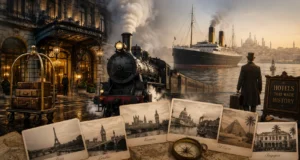
What began with a handful of aristocrats touring Europe by stagecoach ended with thousands of people traveling by train and steamship, staying in hotels that no longer offered just a bed, but comfort, fine cuisine, and an experience that was part of the journey itself.
The Industrial Revolution didn’t just fill factories with machines; it also set the world in motion. Locomotives shortened distances, steamships joined continents, and travel stopped being an adventure reserved for the few.
With every new route came a new hotel, and with every hotel, a different way of understanding hospitality was born.
By the time the 19th century came to an end, the hotel was no longer simply a place to spend the night.
It had become a stage where politics was made, novels were written, recipes still enjoyed today were invented, deals were closed, and adventures began.
Each of the great hotels of this era represented a different way of understanding hospitality, but all shared one same conviction: a great hotel could be much more than a place to sleep.
Without setting out to do so, the hotel industry had begun telling the story of the world.
The 20th century would carry that story even further. Travel would stop being a privilege and gradually become a possibility within reach of millions of people. And hotels would have to transform once again to keep pace with that change.